
Fremont County Court Records After a Jail Arrest
After a Fremont County arrest, the jail record and the court record serve different jobs. The Fremont County Sheriff's Office records intake, custody, alleged booking charges, holds, bond status if known to the jail, and release status. Law enforcement reports then go to the Fremont County Prosecutor for review. Idaho counties use prosecuting attorneys, not district attorneys, and the Fremont County Prosecutor directory lists Lindsey Blake as prosecutor.
The prosecutor decides whether to file a criminal complaint, information, amendment, or other charging document. Once a public criminal case is filed, the court records after the arrest appear through Idaho iCourt/Odyssey when not sealed or excluded from public access. For the jail side of the event, use jail inmate records. For booking photos, use jail mugshots. For filed charges, hearing dates, and dispositions, use the court record.
The Idaho iCourt portal is the public court search route for Fremont County because Fremont County is included in iCourt. Idaho Courts says electronic records are available for all 44 counties, public users do not need to register for basic access, and records are generally updated at least hourly during working-day changes by trial court personnel. Very new filings, sealed matters, juvenile records, and older paper records may still require a clerk contact.
How to Find Fremont County Court Records After an Arrest
Start with the official Idaho iCourt/Odyssey portal when the goal is to see charges filed after a Fremont County jail arrest. iCourt is separate from VINELink. VINELink helps with custody and release notification, while iCourt shows the filed criminal case when public. If the case is too new to appear, call the Fremont County Courthouse at 208-624-7200 or use the clerk route at 151 W 1st North, St. Anthony, ID 83445. The local Magistrate and District Courts page also points users toward iCourt and local court-record request routes.
- Open the Idaho iCourt/Odyssey public portal.
- Use Smart Search with a case number, record number, or party name.
- For a person search, use the Last, First format described in the official tutorial.
- Open the Fremont County criminal case and read the charge entries, docket events, hearing dates, and status.
- Compare the court charge list with any jail booking information because the booking charge can differ from the filed charge.
The official iCourt tutorial also explains that unsealed warrants and no-contact orders can be searched by record number through Smart Search. Public access excludes Social Security numbers, addresses, phone numbers, driver's license numbers, financial account numbers, sealed cases, and other information protected by Idaho Court Administrative Rule 32.
The official iCourt/Odyssey portal screenshot below comes from the successful project image manifest. Open the Idaho iCourt public portal before searching Fremont County charges, because it is the court system rather than a jail roster.
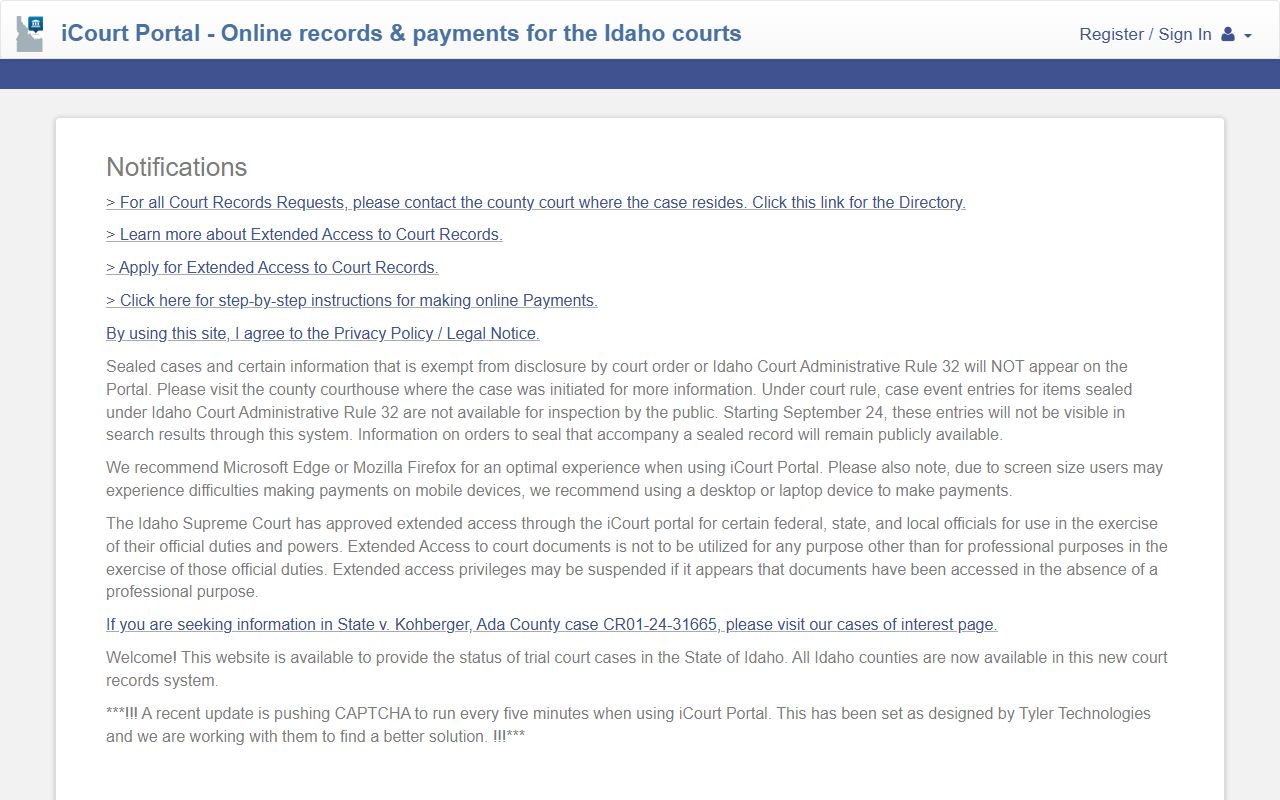
Use the portal for formal court records after arrest, then use the sheriff phone line or JustFOIA if the requested booking record is not part of the court file.
iCourt Search Fields for Court Records After Arrest
Idaho Courts documents the basic public search fields through its portal overview, FAQ, and tutorial. The exact filters can change in the live portal, but the fields below are the Fremont County court-record search elements captured in the research.
| Field Label | Type | Required | How to Use It |
|---|---|---|---|
| Smart Search | Text | Yes | Enter a case number, record number, party name, warrant record number, or other supported search term. |
| Case or record number | Text | No | Use a number from jail paperwork, citation paperwork, bond paperwork, or a court notice when available. |
| Party name | Text | No | For people, use Last, First format, such as Doe, Jane, as described by the official tutorial. |
| Advanced filtering | Filters | No | Use filters to narrow results where the portal exposes them; exact dropdown options can vary. |
| Register / Sign In | Link or button | No | Basic public and media access does not require registration; extended access requires approval. |
How Charges Get Filed After an Arrest: Complaint, Information, and Indictment
Booking happens first, but a charge becomes a court record when a charging document is filed. The prosecutor may file an initial criminal complaint, later file an information in a felony case, amend a charge, reduce a charge, or seek an indictment depending on the facts and procedure. That filing is the point where the arrest record and the court records can start to diverge.
| Document | Who Files or Issues It | Common Use | What to Check |
|---|---|---|---|
| Complaint | Prosecutor, often based on law enforcement reports | Initial criminal filing after arrest, including misdemeanor cases and early felony filings | Count number, alleged statute, offense level, filing date, and whether it was later amended. |
| Information | Prosecutor | Many felony cases after prosecutor review and required procedure | Whether the information replaced or narrowed the initial booking allegation. |
| Indictment | Grand jury | Serious or grand-jury-filed felony matters | Filed counts and whether public access is limited by court order. |
| Amended charge | Prosecutor with court process | Corrected, reduced, added, or replaced counts | The current charge status, not just the first charge visible after booking. |
Charge Status and What It Means
Filed charges are not static. A Fremont County court record after arrest may show one allegation at filing and a different status later. Prosecutors can amend or reduce charges, judges can dismiss counts, a defendant can plead guilty, or a case can end with acquittal, deferred judgment, dismissal, or another order. Always read the latest docket entries and disposition, not only the first charge line.
| Status | What It Means |
|---|---|
| Pending | The charge remains active and unresolved in court. |
| Amended | The prosecutor changed the filed charge, wording, count, or statutory basis. |
| Reduced | The charge was lowered to a lesser offense or lesser level. |
| Dismissed | That count ended without a conviction on the count shown as dismissed. |
| Disposition | The final outcome, such as guilty plea, dismissal, acquittal, deferred judgment, or other order. |
| Conviction | A final finding or judgment of guilt. It is not the same thing as arrest, booking, or charge filing. |
Bond and Release After an Arrest
Fremont County did not publish a local bond desk procedure in the official sources located. The practical workflow is to confirm custody with the sheriff at 208-624-4482 or through VINELink, ask whether bond has been set, check iCourt for bond-related docket entries after the criminal case is filed, and confirm payment instructions with the sheriff or court before sending money.
Idaho Criminal Rule 5 requires an arrested defendant to be taken before a magistrate without unreasonable delay and no more than 24 hours after arrest, excluding Saturdays, Sundays, and holidays. The rule also covers key first-appearance advisements, including the right to bail, right to counsel, and the nature of the charges. Idaho Title 19, Chapter 29 is the Idaho Bail Act and governs bail, release conditions, posting, forfeiture, revocation, and exoneration.
| Bond Type | How It Works |
|---|---|
| Cash Bond | The full amount is paid as ordered by the court or accepted by the proper office. |
| Surety Bond | A licensed bail agent or surety posts the bond; fees and collateral are separate from court refund rules. |
| Personal Recognizance | Release is based on a promise to appear, usually with written conditions. |
| Property Bond | Real or other property may secure release if allowed by the court. |
| No-Bond Hold | Release is blocked until a judge or holding agency changes the status. |
A hold can keep someone in custody even after local bond is posted. Common examples include another county's warrant, a probation or parole hold, a bench warrant in another case, a federal or U.S. Marshals hold, an ICE detainer, or an IDOC transfer after sentencing.
Warrants That Lead to an Arrest
No official Fremont County sheriff active-warrant list, warrant search, or most-wanted database was located in the county materials. For local warrant questions, call the Fremont County Sheriff's Office at 208-624-4482. The Drug and Crime Hotline, 208-624-1538, is a tip line, not a warrant-clearance line. For court-linked warrants, use iCourt Smart Search where the warrant or no-contact order is public and the record number is known.
| Warrant Type | How It Can Affect Jail and Court Records |
|---|---|
| Arrest warrant | Authorizes arrest in a criminal matter and can lead to booking at the Fremont County Jail. |
| Bench warrant | Issued by a judge, often for failure to appear or violation of a court order. |
| Search warrant | Authorizes a search and is not the same as a public self-surrender custody lookup. |
| Out-of-county warrant | Can create a hold even if the Fremont County case has a bond. |
Do not assume that walking into court or the sheriff's office will clear an active warrant without arrest. Contact the court or sheriff first, ask whether bond or a court appearance is required, and consider legal counsel.
Charges vs. Convictions
A jail arrest and a criminal charge are accusations. A conviction is a final finding or judgment of guilt. Court records after an arrest can show both charges and final dispositions, so read the status of each count before treating a record as a conviction record.
| Charge | Conviction | |
|---|---|---|
| Stage | Filed accusation after prosecutor review or other charging process | Final guilty plea, verdict, or judgment |
| Meaning | The case or count is alleged, pending, amended, reduced, or otherwise unresolved until disposition | The court has entered a guilt-based final outcome |
| Where to Check | iCourt charge entries, complaint, information, indictment, and docket | iCourt disposition, judgment, sentencing entries, and any later orders |
Sealed vs. Expunged Arrest Records
Idaho access rules use careful language. Idaho Court Administrative Rule 32 controls public access to court records and excludes confidential or sealed information. Idaho's Clean Slate Act materials describe eligible criminal records being shielded from public disclosure after at least five years since completion of sentence, including probation, parole, fines, and restitution. Shielding does not destroy the record.
| Sealed or Shielded | Expunged | |
|---|---|---|
| Visibility | Hidden from general public access when a rule, statute, or court order applies | Destroyed or treated as though it did not exist only where a specific law authorizes that result |
| Idaho Research Note | The Clean Slate Act source describes shielding from public disclosure, not destruction | Do not assume expungement of every Fremont County arrest or dismissal |
| Eligibility | Depends on sentence completion, waiting periods, record type, and court process | Depends on the specific Idaho statute or court order involved |
Background Check Considerations
Casual public-record lookup is not the same as an FCRA-compliant background check. Court records after a jail arrest can be incomplete, sealed, amended, or misunderstood if the disposition is ignored. Employers, landlords, lenders, insurers, and other regulated users must follow the laws that apply to consumer reports and adverse-action decisions.
Important: Fremont County Inmate Population is not a consumer reporting agency and cannot be used for FCRA-covered screening.
Restricted Court Records After an Arrest in Fremont County
Idaho Code 74-102 generally supports inspection and copying of public records unless another law applies. Idaho Code 74-124 allows certain law-enforcement records to be withheld or redacted when disclosure would interfere with enforcement, fair trial rights, privacy, confidential sources, investigative techniques, safety, or reporting-party identity. ICAR 32 also keeps confidential, sealed, and shielded court materials out of public access.
If a Fremont County court record after arrest returns no result, the reason may be timing, spelling, a sealed case, juvenile confidentiality, an old paper file, or a case that was not filed. Use the Fremont County Clerk/Courthouse at 208-624-7200 for court-record questions and the county's JustFOIA public records request portal for booking sheets, arrest reports subject to redaction, or jail records not posted online.